
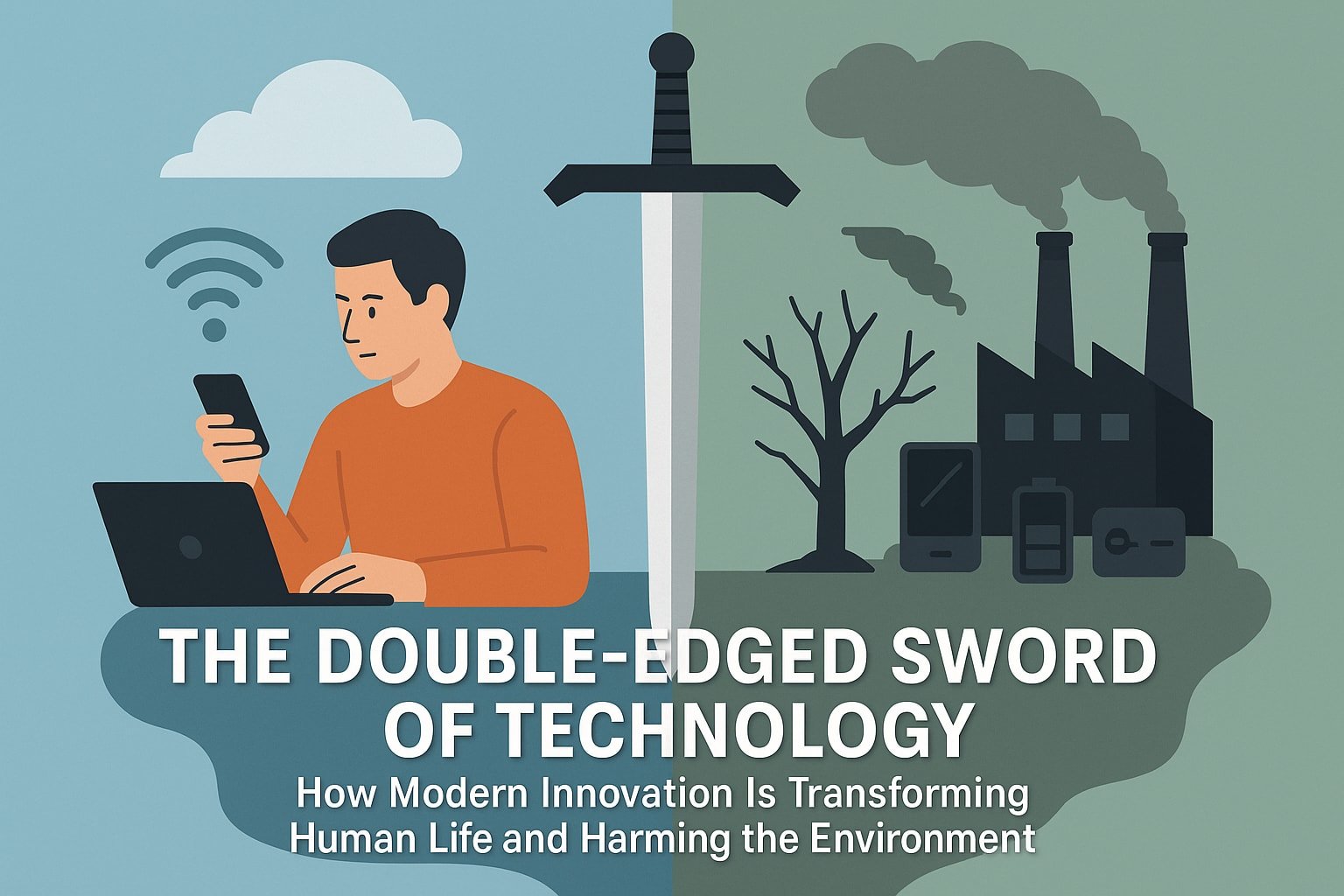
For all its promise of a utopian future, a nagging question lingers in the back of every tech enthusiast's mind: Are we building a better world or architecting our own obsolescence? We're surrounded by unprecedented advancements, from artificial intelligence to genetic engineering, yet a growing sense of anxiety is palpable. It’s a feeling that we may have pushed too far, too fast, without a map for the road ahead.
In a Nutshell
- Economic Upheaval: Advanced AI and automation threaten to displace workers at a rate that outpaces job creation, creating a potential for widespread economic instability and exacerbating inequality.
- Ethical & Social Erosion: The unregulated rise of technologies like social media algorithms, deepfakes, and genetic editing poses significant risks to our mental well-being, social cohesion, and the very concept of a shared reality.
- Unseen Environmental Costs: Beyond the obvious, the digital age carries a heavy environmental burden, from the immense energy thirst of data centers to the mounting global crisis of electronic waste.
Unpacking Our Tech-Fueled Anxiety
New technology can harm our future by causing widespread job displacement through automation, deepening economic and social inequalities, and creating unprecedented ethical crises. The rapid, unregulated pace of development also poses significant risks to mental well-being and environmental sustainability.
This isn't just a niche concern. It’s a sentiment bubbling up from the very communities that once championed unbridled innovation. As one user on Reddit’s r/Futurology forum put it, "I just feel we have reached a point now where tech is so pervasive that going any further isn't just unneccessary, but that it could only be damaging. Things like AI, machine learning, virtual and augmented reality… they scare me."
This fear isn't about being anti-progress. It's about questioning the nature of that progress and who it truly serves. We are at a critical juncture where the potential downsides are becoming too large to ignore.
Economic Upheaval: Job Apocalypse Myth vs. Reality
Advanced AI and automation threaten to displace workers faster than new jobs can be created, potentially leading to mass unemployment and an economic crisis. Unlike past technological shifts, AI can impact both blue-collar and white-collar jobs, raising fears of systemic, long-term disruption.
My big fear," confessed a Quora user, "We're really unprepared for the level of upheaval that tech innovation will cause in the economy. I fear we will innovate so many people out of jobs faster than they can train for new ones." This sentiment echoes a stark warning from the late Stephen Hawking: "The development of full artificial intelligence could spell the end of the human race… Humans, who are limited by slow biological evolution, couldn't compete, and would be superseded."
While some argue that technology always creates new jobs, citing how the automobile replaced the horse-and-buggy industry, this comparison may be dangerously simplistic. The World Economic Forum's Future of Jobs Report predicts that while 170 million new jobs could be created by 2030, a staggering 92 million will be displaced in the same period. The issue isn't just job loss; it's the velocity of the change and the potential for a skills gap so vast it leaves millions behind.
Widening Chasm of Inequality
The danger isn't just unemployment, but a profound deepening of societal divides. As we move into an era of advanced biotechnology, the threat transcends the economic and touches the biological. Dr. Tedros Adhanom Ghebreyesus, WHO Director-General, cautioned that human genome editing "will only be realized if we deploy it for the benefit of all people, instead of fueling more health inequity." The alternative is a dystopian future where the wealthy can afford genetic enhancements, creating a literal biological caste system.
Redefining Reality: Cognitive and Social Costs
Modern technology, particularly social media algorithms and immersive virtual worlds, can harm our cognitive functions and social fabric. These systems may reduce our ability for deep focus, foster a chronic feeling of not being present, and erode the shared sense of reality necessary for a functional society.
Observing market shifts over recent years, a clear pattern emerges: the attention economy is exacting a heavy cognitive price. Many of us feel it. A Reddit user on r/digitalminimalism poignantly described it as "a chronic feeling of not being present or alive." This isn't just about distraction; it's a fundamental alteration of our ability to engage with the world deeply. Our brains are being rewired for constant, shallow stimulation.
This digital fog is compounded by a more sinister threat: the erosion of shared reality. Algorithms create echo chambers that reinforce our biases, a problem experts at Holistic AI note can cause unintentional harm by reinforcing stereotypes. [cite: none] Add the rise of hyper-realistic deepfakes and AI-generated content, and the very foundation of a democratic society—a shared set of facts—begins to crumble.
Environmental Toll: Our Planet's Hidden Digital Debt
The environmental harm of new technology comes from the immense energy consumption of data centers and cryptocurrency mining, as well as the unsustainable cycle of manufacturing and disposal. The proliferation of electronic waste (e-waste) and the mining of rare-earth minerals present significant, often overlooked, ecological challenges.
We often think of the digital world as clean and ethereal. The reality is anything but. Data centers, the backbone of the internet and AI, are energy vampires. By 2026, their electricity consumption is projected to exceed 1,000 terawatt-hours annually—more than the entire energy consumption of Japan.
But the problem starts long before a server is ever switched on. It begins with the resource-intensive mining of rare-earth minerals and ends with a mountain of e-waste. In 2022, the world generated 62 million tonnes of electronic waste, and that number is on track to hit 82 million tonnes by 2030. Shockingly, less than a quarter of it was properly recycled, leaving billions of dollars in recoverable materials—and a toxic legacy—in landfills.
Forging a Better Future: Path to Proactive Governance
So what can be done? The solution isn't to smash the machines but to seize the steering wheel. We are suffering from a critical governance vacuum, where technology develops at lightning speed while regulation and ethical frameworks lag years behind. We need to flip the script: ethics must come first.
Proactive governance means creating robust regulatory bodies that can audit algorithms for bias before they are deployed. It means establishing international treaties on the development of artificial general intelligence. It requires holding corporations accountable for the entire lifecycle of their products, from mineral sourcing to e-waste recycling.
Quick Action Plan:
- Demand Transparency: Support policies that require companies to be transparent about their algorithms and data usage.
- Champion Digital Literacy: Advocate for education that teaches critical thinking in the digital age, helping people identify misinformation and understand technological influence.
- Vote with Your Wallet: Support companies that prioritize ethical design, user well-being, and environmental sustainability.
Your Role in an Uncertain Tech Future
We stand at a crossroads. The tools we are building have the power to create a future of unprecedented prosperity and health, or one of deep division and existential risk. The trajectory is not set. It will be determined by the choices we make today—as consumers, as citizens, and as creators.
The critical question we must ask is not can we build it, but should we? And if we do, what safeguards must we demand to ensure that our creations serve humanity, not supersede it? The conversation about our technological future is too important to be left only to the CEOs in Silicon Valley. It belongs to all of us.
References / Sources
[1] DTP Group: 50+ E-Waste Statistics 2026
[2] Tech Speak: How the Rise of Data Centres Is Reshaping Global Energy Demand
[3] Coursera Blog: WEF Future of Jobs Report 2025 reveals a net increase of 78 million jobs by 2030