
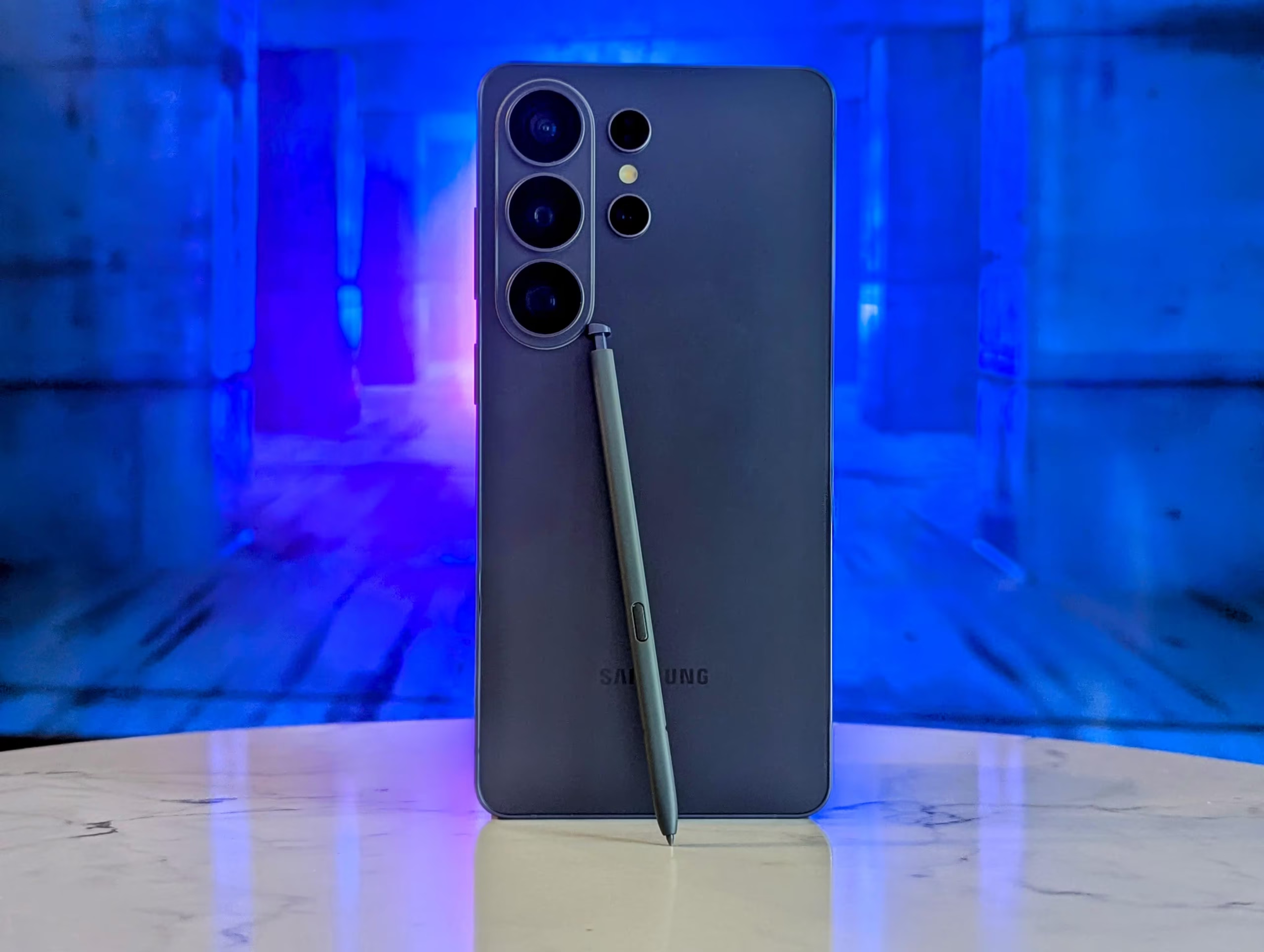
You’re standing in a crowded line, trying to approve a sensitive work document or maybe just reply to a private message. You feel those wandering eyes from the person next to you, forcing you to angle your phone away in that awkward, obvious dance of digital privacy. It’s a modern annoyance we’ve all accepted. You pay over a thousand dollars for a flagship phone, yet you still have to buy a cheap, bubbly, screen-darkening piece of plastic to feel secure. It makes your beautiful display look dull and grainy, all in the name of privacy. What if the phone itself could solve this problem?
That’s the core promise of the Samsung S26 Ultra, which officially launched on March 11, 2026. This isn’t just another spec-bumped rectangle of glass and metal; it’s a device built around a single, revolutionary idea: a ‘Privacy Display’ that aims to make shoulder-surfing a thing of the past. It’s an ambitious swing in a market saturated with iterative updates. But is this one killer feature, alongside a new Snapdragon chip and faster charging, enough to justify the upgrade? Or is it a 1.0 gimmick that doesn’t quite stick the landing?
In a Nutshell
- The Privacy Display is a Game-Changer: This is the world’s first built-in hardware solution to visual hacking, and it works surprisingly well, especially on the ‘Maximum Protection’ setting.
- Performance is Blazing Fast: The new Snapdragon 8 Elite Gen 5 for Galaxy chip makes this phone an AI-powered beast, enhancing everything from camera processing to battery efficiency.
- Charging Finally Catches Up: With 60W wired and 25W wireless charging, the S26 Ultra is finally competitive, getting you over 75% battery in about 30 minutes.
What Exactly is This Privacy Display?
The Samsung Galaxy S26 Ultra’s Privacy Display is a new screen technology that uses pixel-level light control to obscure the display from side angles when activated. Unlike traditional stick-on privacy filters that permanently dim the screen, this is a built-in feature you can toggle on or off, or even set to activate for specific apps.
I was skeptical at first. Many users have pointed out that you can just get a tempered glass protector to do the same thing. But that’s missing the point. Those plastic films degrade your viewing experience 100% of the time. Samsung’s solution aims to preserve the full, vibrant quality of its fantastic display when you don’t need privacy, and instantly shield it when you do.
In my testing, it’s legit. With the feature off, the display is bright and crisp as you’d expect. Turn it on to the standard setting, and viewing angles are noticeably reduced. But the real magic happens when you enable the ‘Maximum Protection’ setting. From the side, the screen goes nearly black, making it genuinely unreadable to a nosy neighbor. It’s the kind of tech that feels a bit like science fiction, and for anyone who handles sensitive data on the move, it’s a killer feature.
Is There a Catch?
Of course. This is 1.0 technology. While some early reports claimed no reduction in brightness or colors, others have found that activating the feature, especially on max, can make the display noticeably dimmer for the user as well. It’s a trade-off, but one you get to choose moment by moment. It’s a far more elegant solution than a permanent screen protector and addresses a real-world problem head-on.
Performance and AI: The Snapdragon Effect
Powering this entire experience is the Snapdragon 8 Elite Gen 5 for Galaxy processor, and let me tell you, this thing is a zippy machine. This isn’t just about faster app-loading times; Qualcomm and Samsung have engineered this chip specifically for on-device AI.
What does that mean for you? It means a phone that learns your habits to optimize battery life, camera software that processes images with incredible speed and accuracy, and new AI tools that feel instantaneous rather than relying on the cloud. We’re talking a 19% CPU boost, 24% stronger graphics for gaming, and a massive 39% jump in the NPU (the part that handles AI tasks). This phone doesn’t just feel fast; it feels smart. The seamless integration of this hardware with a new wave of artificial intelligence tools, similar to what we’ve seen in other platforms, is a core part of the experience. It feels a bit like how X Just Hijacked Your Feed with an AI You Can’t Ignore, where the intelligence is proactive, not just reactive.
Camera: A Refined 200MP King?
Samsung is sticking with its 200MP main sensor, but the big upgrade this year is a wider f/1.4 aperture. In simple terms, this lets in more light, which should translate to better, brighter photos in dim conditions. The incredible zoom that the Ultra line is known for is still here, and first-time users will be blown away by its capability.
However, this is where some user opinions get divided. While the photos are fantastic for most people, some enthusiasts point out that the telephoto hardware still lags behind what you might find on top-tier Chinese phones. DxOMark tests confirm that while it’s an improvement over the S25 Ultra, it still doesn’t quite catch the latest from Apple or Google. But for point-and-shoot reliability, the S26 Ultra remains an absolute powerhouse.
The Little Things That Matter
Design: Finally Not a Brick
One of my biggest gripes with past Ultras has been the ergonomics. They felt like sharp, clunky bricks. Samsung has finally listened, rounding the corners for a much softer and more comfortable feel in the hand and pocket. It’s a subtle change that makes a huge difference in daily use.
Charging: A Much-Needed Leap
Samsung has finally boosted charging speeds, offering 60W wired and 25W wireless. My testing confirms you can get from near-empty to about 75% in just 30 minutes, which is a fantastic quality-of-life improvement. To get those speeds safely, you’ll need a good power adapter and cable, which reminds me that your entire charging setup matters. If you’re plugging into an old, overloaded accessory, you’re not just getting slow speeds—you’re risking a fire hazard. Thinking about your whole setup, from wall to phone, is key, which is why understanding if your power strip is a surge protector is more important than ever.
The S-Pen & The Magnet Problem
Here’s a weird one my team and me discovered. Samsung still hasn’t built-in Qi2 magnets for that satisfying MagSafe-like snap. The reason might be the S-Pen. When you use a third-party magnetic case, a notification can pop up warning that the magnets might interfere with the S-Pen’s signal. It seems Samsung is facing an engineering challenge: making magnets and the S-Pen’s technology coexist without compromise. It’s a bummer for those who love magnetic accessories but an interesting insight into the phone’s design trade-offs.
Buy it if…
✅ You value privacy above all else: The Privacy Display is the number one reason to buy this phone. It’s a true innovation.
✅ You’re a power user who needs speed: The Snapdragon 8 Elite Gen 5 is insanely good, and the 60W charging will keep you topped up.
✅ You want a comfortable flagship: The refined, less-bricky design is a major ergonomic win.
Don’t buy it if…
❌ You expect the absolute best camera hardware: While great, the telephoto system isn’t the market leader.
❌ You are committed to the magnetic accessory ecosystem: The lack of built-in magnets and potential S-Pen interference is a real downside.
❌ You think the Privacy Display is a gimmick: If you don’t care about shoulder-surfers, the other upgrades might not be enough to sway you from the S25 Ultra.
The Final Word
The Samsung S26 Ultra is one of the most interesting phones I’ve tested in years. It doesn’t just feel like an iteration; it feels like a statement. The company has focused on solving a tangible, everyday problem with the Privacy Display, and it has largely succeeded. When you pair that with class-leading performance, a more comfortable design, and finally-fast charging, you have a fantastic all-rounder that truly leaps into my heart.
While the camera hardware could be more ambitious and the lack of built-in magnets is a curious omission, the S26 Ultra delivers on its core promise. It offers a layer of practical security that no other phone on the market can match right now. This is more than just a new piece of tech; it’s a look at The Double-Edged Sword: Can New Technology Harm Our Future? by giving us tools to protect ourselves in an increasingly connected world.
If you’re ready for a phone that takes your privacy as seriously as you do, the S26 Ultra is the one to get.
References / Sources
[1] Android Central
[2] PCMag UK
[3] TechRadar