
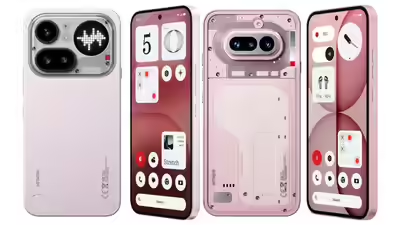
In a market saturated with iterative flagships demanding ever-higher prices, Nothing has made a bold and refreshingly honest pivot. Instead of forcing another high-end contender into the ring, the company has doubled down on what its users actually love: distinctive design, a snappy user experience, and intelligent pricing. The result is the Nothing Phone 4a and 4a Pro, two of the most compelling budget-to-mid-range devices available today.
These phones aren't trying to beat the Samsung Galaxy S26 Ultra at its own game. Instead, they carve out a new space, offering a thoughtful alternative to the underwhelming Google Pixel 10a and the pricier iPhone 17e. After spending considerable time with both models, it's clear that Nothing's strategy isn't just a concession to market realities; it's a masterclass in understanding the modern smartphone user.
At a Glance
- Exceptional Value: The Phone 4a starts at just €349, offering a triple-camera system and high-refresh-rate OLED display that puts competitors to shame.
- Stunning Design: Both models, especially the blue 4a, are arguably the best-looking phones Nothing has ever produced, featuring the brand's signature semi-transparent aesthetic.
- Refined Software Experience: Nothing OS 4.1 running on Android 16 is incredibly smooth and responsive, proving you don't need a flagship chip for a premium feel.
Design & Build: A Tale of Two Tiers
The Nothing Phone 4a and 4a Pro are two mid-range smartphones that prioritize unique design and a fluid user experience over raw processing power. The standard 4a focuses on delivering maximum value with a high-quality plastic build, while the 4a Pro emulates a flagship feel with a unibody aluminum frame and a more advanced rear display.
Nothing has always been a design-first company, and these phones are the strongest expression of that ethos yet. They manage to feel special and intentional in a sea of generic glass slabs, and the approach to materials for each model is perfectly suited to its price point.
The 4a: Playful and Practical
The standard Phone 4a, particularly in its striking blue color, is an immediate standout. The matte blue finish on the sides provides a comfortable and secure grip, flowing seamlessly into the semi-transparent plastic back. This isn't cheap, glossy plastic; it feels durable and thoughtfully constructed, showcasing the intricate textures and classic dotted text beneath the surface. It's a design that invites you to look closer.
This practical material choice means it's less prone to fingerprints and smashes compared to an all-glass phone. For a device priced at €349, this level of design identity is a massive advantage. It's protected by Gorilla Glass 7i on the front and has an IP64 rating, which means it can handle splashes without any issue. This is the kind of practical durability that brings peace of mind for daily use.
The 4a Pro: A Premium Illusion
Picking up the $499 Phone 4a Pro for the first time, the difference is immediate and tactile. The switch to a unibody aluminum frame gives it the cold, rigid feel you expect from a phone costing twice as much. It successfully emulates the in-hand sensation of a top-tier flagship.
This premium feel is enhanced by the design of the camera housing. The triple-lens array and the new Glyph Matrix are set within a clear cutout, creating a visually impressive, layered look. The bezels around the display are also slightly thinner, which allows for a marginally larger screen in a slightly smaller body. However, this premium material comes with a frustrating downside: the aluminum is an extreme fingerprint magnet and is bizarrely difficult to clean.
Nothing Phone 4a vs. 4a Pro: Key Differences
Price (4a)
Price (4a Pro)
Build (4a)
Build (4a Pro)
Performance & Software: Nothing OS Hits Its Stride
Nothing's secret sauce has always been its software, and with Nothing OS 4.1, the experience is more refined than ever. The company understands that specs on paper don't always translate to real-world feel. By focusing on optimization, they deliver a level of smoothness that punches far above the phones' weight class.
The "Snappy Factor"
The Phone 4a runs on the Snapdragon 7S Gen 4, while the 4a Pro gets a slightly more powerful Snapdragon 7 Gen 4. While neither is a top-of-the-line chip, they are more than capable. In my testing, I found that most people would be hard-pressed to tell the difference between these phones and a flagship in day-to-day tasks. The major upgrade to UFS 3.1 storage is a huge contributor here; this advantage means apps launch faster and the whole system feels more responsive.
This fluid performance is the direct benefit of Nothing's software optimization. The animations are buttery smooth across the high-refresh-rate OLED displays, and I never encountered any frustrating lag or stuttering. This focus on the user experience is precisely why people are drawn to Nothing phones, and it's something many other brands overlook in the mid-range.
Customization and Community
Nothing OS 4.1 also brings more customization features to the home screen. You now have greater control over how folders appear, allowing for a more personalized layout. What truly sets it apart, however, is the Playground—a community-driven web store for custom widgets.
I was genuinely impressed by the creativity here. I added a widget that's a literal arcade game and another that counts down the remaining time in the day, week, month, and year. This level of unique personality is something I find myself missing when I switch to other Android phones. It gives the device a character that no other manufacturer can replicate.
Glyph Interface: From Notification Light to Information Hub
The lights on the back are Nothing's most iconic feature, and they've evolved significantly. The core benefit remains the same: encouraging you to keep your phone face down, reducing distractions, and letting you engage only when necessary.
On the Phone 4a, the Glyph interface is a simple, straight bar of seven LED dots. This bar serves as a volume indicator, a progress bar for things like an Uber arrival, and a countdown timer. It also includes a red dot at the bottom that blinks as a video recording indicator—a genuinely useful feature more phones should adopt.
Conversely, the Phone 4a Pro introduces the Glyph Matrix, a full pixel-style display on the back. This is a scaled-up, brighter version of the array from the Nothing Phone 3. It allows for fully customizable icons to be displayed for specific notifications. For example, I set it to show a specific icon for a missed Slack message and a heart for a message from a specific contact. This is a powerful advantage for at-a-glance information.
However, the implementation isn't perfect. I wish I could draw my own pixel art for notifications, and it's a real shame that the intricate countdown timer animation doesn't integrate with the phone's built-in clock app. It's a cool gimmick, but one I'll likely never use because of that oversight.
| Feature | Nothing Phone 4a | Nothing Phone 4a Pro |
|---|---|---|
| Starting Price | €349 | $499 |
| Processor | Snapdragon 7S Gen 4 | Snapdragon 7 Gen 4 |
| Body Material | Plastic Frame, Semi-Transparent Back | Unibody Aluminum Frame |
| Storage | Starts at 128GB (UFS 3.1) | Starts at 128GB (UFS 3.1) |
| Display | 120Hz LTPS OLED (4500 nits peak) | 144Hz LTPS OLED (5000 nits peak) |
| Cameras | Triple: 50MP Main, 8MP Ultrawide, 3.5x Telephoto | Triple: 50MP Main, 8MP Ultrawide, 3.5x Telephoto |
| Glyph Interface | 7-Dot LED Bar | Full Pixel-Style Matrix Display |
| Water Resistance | IP64 (Splash Resistant) | IP65 (Water Jet Resistant) |
| Wireless Charging | No | No |
Camera System: Setting Realistic Expectations
One of the biggest features on the spec sheet is the triple-camera system on both phones, especially when competitors like the Pixel 10a and iPhone 17e offer dual or even single lenses. This gives you the advantage of versatility, with a 50MP main sensor, an 8MP ultrawide, and a 3.5x telephoto lens.
The real-world benefit is the ability to frame your shots exactly how you want, whether you need to capture a wide landscape or zoom in on a distant subject. However, no one should buy these phones expecting flagship-level camera performance. The photos I captured were perfectly serviceable for social media, but they often leaned a bit too heavily on HDR processing and could be noisier than I expected, especially in lower light.
There are also some hard limitations. Because both phones use an 8-megapixel sensor for the ultrawide camera, neither can shoot 4K video from that lens. Furthermore, while the Pro model boasts a headline-grabbing 140x "Ultra Zoom," it's nothing more than a digital crop. The results are unusable, and it feels like a gimmick designed to inflate the spec sheet. The Pro model offers very little tangible camera improvement over the standard 4a.
Pros & Cons
| Pros | Cons |
|---|---|
| ✅ Beautiful and unique design | ❌ Camera quality is merely average |
| ✅ Extremely competitive pricing | ❌ No wireless charging on either model |
| ✅ Smooth, snappy OS performance | ❌ Pro model's upgrades feel minimal for the price |
| ✅ Useful and fun Glyph Interface | ❌ Aluminum Pro body is a fingerprint nightmare |
| ✅ Triple cameras offer versatility | ❌ Some Glyph features feel gimmicky |
Final Verdict & Rating
Nothing's decision to sidestep the hyper-competitive flagship market was a stroke of genius. By focusing on the mid-range, they've delivered two phones that offer a truly unique and satisfying experience without an exorbitant price tag. The software is a joy to use, the designs are second to none, and the core performance is more than enough for the vast majority of users.
While both phones are good, the standard Nothing Phone 4a is the undeniable star of the show. For €349, you are getting a device with more character, better features, and a more thoughtful design than anything else in its class. It is the phone I would recommend to almost anyone looking for the best value on the market today.
The Nothing Phone 4a Pro is a slightly tougher sell. At $499, the $150 premium gets you a metal body that feels great but is impractical, a slightly faster chip you may not notice, and a more advanced Glyph system with limited utility. It's a fine phone, but it doesn't represent the same monumental value as its cheaper sibling. For US buyers who don't have access to the standard 4a, it's still a solid choice, but for everyone else, the base model is where the magic is.
Nothing Phone 4a: 8.5 / 10
Nothing Phone 4a Pro: 7.5 / 10